
Somatic Therapy for Trauma in Atlanta, Georgia
Trauma can live in the body long after the danger has passed. For women dealing with PTSD, hypervigilance, shutdown, panic, or stress that feels stuck in the nervous system, somatic therapy offers a body-based path to healing. At Revelare Recovery in Atlanta, we use somatic therapy to help women understand and regulate trauma responses that may not fully resolve through talk therapy alone. As part of our trauma-informed treatment approach, somatic work can support greater safety, grounding, and connection to your body during recovery.
What Is Somatic Experiencing Therapy?
Somatic experiencing is a body-based approach to healing trauma, developed by Dr. Peter Levine. The core idea is that trauma isn’t only a memory stored in the mind — it’s energy that gets trapped in the nervous system when a threatening experience overwhelms the body’s ability to respond. That trapped activation is what keeps people feeling on edge, shut down, or reactive months or years after the event.
Rather than re-telling the traumatic story in detail, somatic therapy pays attention to physical sensation: tension, temperature, tightness, the impulse to move. A trained practitioner guides you to notice these sensations slowly and in small doses, so the nervous system can discharge what it’s been holding and settle back toward a regulated state. Over time, the body relearns that it’s safe.
Somatic therapy is often called “somatic experiencing therapy” or simply body-based therapy. At Revelare, it’s one part of a trauma-informed treatment approach delivered by clinicians trained in the method.
Find out if your insurance will cover the cost of treatment.
"*" indicates required fields
What Conditions Can Somatic Therapy Help?
Somatic work is most useful when distress has a strong physical grip — when the body reacts before the mind catches up. Our clinicians use it to support women dealing with:
- Trauma and PTSD — flashbacks, hypervigilance, and the sense of being stuck in a threat response. Somatic therapy pairs well with our trauma and PTSD treatment for women in Atlanta.
- Anxiety — the physical churn of a nervous system that won’t stand down: chest tightness, shallow breathing, a stomach in knots. It’s a natural complement to our anxiety treatment.
- Eating disorders — for many women, disordered eating is tied to a fractured relationship with the body itself. Somatic therapy helps rebuild that connection alongside structured eating disorder treatment.
- Chronic stress and burnout — when months of pressure have left the body permanently braced, somatic work helps it remember how to rest.
It’s rarely a standalone fix. Somatic therapy tends to work best woven into a broader treatment plan.
What a Somatic Therapy Session Looks Like
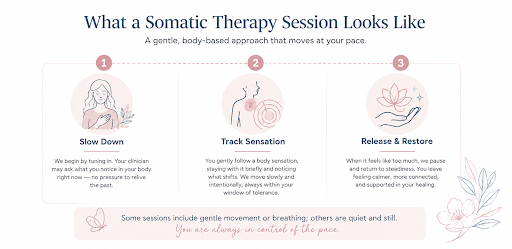
If you’ve only ever done talk therapy, a somatic session can feel different at first. You won’t be pushed to recount the worst thing that ever happened to you. Instead, a session usually starts slow — a clinician might ask what you notice in your body right now, whether that’s a clenched jaw or a knot under the ribs.
From there, the work is gradual. You track a sensation, stay with it briefly, and notice what shifts. When something feels like too much, you pause and come back to a sense of steadiness before continuing. This deliberate pacing is intentional: moving too fast can re-trigger the very response you’re trying to release. Some sessions involve gentle movement or breathing; others are mostly quiet noticing. You stay in control of the pace the entire time.
People often leave a session feeling calmer and, sometimes, a little tired — the kind of tired that comes after the body finally puts something down.
Somatic Therapy vs. Talk Therapy
Talk therapy — CBT, DBT, and similar approaches — works with thoughts, beliefs, and behaviors. It’s powerful for reframing how you interpret a situation and for building coping skills. But some trauma responses don’t respond to reasoning, because they’re held below the level of conscious thought. You can understand exactly why you’re safe and still feel your body brace anyway.
That’s the gap somatic therapy fills. It works from the body up instead of the mind down. Rather than talking about a feeling, you work with where and how it lives physically. For many women, the two approaches together are stronger than either alone: talk therapy makes sense of the story, somatic therapy releases what the body is still carrying.
How Somatic Therapy Fits Into Treatment at Revelare
Somatic therapy isn’t a bolt-on at Revelare — it’s integrated into our broader therapy programs. Depending on your needs, it may be part of a Partial Hospitalization Program (PHP) or Intensive Outpatient Program (IOP), combined with other modalities.
It pairs especially well with EMDR therapy, another approach that addresses how trauma is stored rather than just discussed. Both sit inside our trauma-informed care framework, which shapes how every clinician on our team approaches the women we treat. Your care team coordinates these pieces so somatic work reinforces the rest of your treatment instead of running parallel to it.
Why Choose Revelare for Somatic Therapy in Atlanta
Revelare Recovery is a women’s mental health and recovery program based in Atlanta, Georgia. Somatic experiencing is delivered by clinicians trained in the method, within a program built specifically around the way trauma, anxiety, and eating disorders show up for women. That focus matters — treatment isn’t generic, and neither is the population we serve.
We keep our programs structured but personal, with care teams who coordinate across modalities rather than handing you off. If you’re comparing local providers, that integration — somatic work embedded in real clinical treatment, not offered in isolation — is what sets us apart.
Frequently Asked Questions on Somatic Therapy
Is somatic therapy evidence-based?
Somatic experiencing has a growing body of research supporting its use for trauma and PTSD, and it’s widely used within trauma-informed treatment settings. At Revelare, it’s delivered by trained clinicians as part of an evidence-informed treatment plan rather than on its own.
How many somatic therapy sessions will I need?
It varies. Some women notice a shift in nervous-system regulation within a handful of sessions; for others, somatic work continues over the course of a longer treatment program. Because we integrate it into PHP, IOP, and outpatient care, the number of sessions depends on your overall plan.
Does somatic therapy replace talk therapy?
No. Most people benefit from both. Talk therapy works with thoughts and behaviors; somatic therapy works with what the body holds. They tend to reinforce each other.
Do I have to talk about my trauma in detail?
No. Somatic therapy focuses on physical sensation and pacing, not on recounting every detail of what happened. You stay in control of what you share and how quickly you move.
Begin Somatic Therapy in Atlanta
If trauma, anxiety, or an eating disorder has left you feeling stuck in your own body, somatic therapy can help you find your way back. Our Atlanta team is ready to talk through whether it’s right for you.
Call us today to speak with our team, verify your insurance in a few minutes, or contact our admissions team to get started.