PHP vs IOP for Eating Disorders: Which Level of Care Is Right for You?
When you start looking into eating disorder treatment, the terms pile up fast. Partial hospitalization, intensive outpatient, residential, step-down. It can be hard to tell what each one means, let alone which one fits you.
At Revelare Recovery in Atlanta, we treat women through two levels of care: a partial hospitalization program (PHP) and an intensive outpatient program (IOP). This page explains how they differ, who each one tends to suit, and how the right starting point gets decided. You don’t have to figure it out alone.
What Is an Eating Disorder PHP Program?
An eating disorder PHP program is the most structured form of outpatient care. You spend most of the day in treatment, several days a week, then go home in the evening. At Revelare, our partial hospitalization program runs full days, several days a week. Women who live outside the immediate area can stay in our supportive housing near the center.
A day in PHP typically includes group and individual therapy, supported meals and snacks, and nutrition counseling with a registered dietitian. Because so much of the day is spent in treatment, PHP gives you steady support around food and difficult emotions while you still sleep at home.
PHP often suits women who:
- Need daily structure to interrupt eating disorder behaviors like restricting, bingeing, or purging
- Find meals hard to manage alone and benefit from support at most meals during the day
- Are medically stable and don’t need 24-hour care, but need more support than a few sessions a week can offer
- Are stepping down from a residential or inpatient program elsewhere and want to keep momentum
Find out if your insurance will cover the cost of treatment.
"*" indicates required fields
What Is an Eating Disorder IOP Program?
An eating disorder IOP program offers regular, structured treatment with fewer hours each week. At Revelare, our intensive outpatient program meets a few days a week for part of the day. That leaves room for work, school, or family while you continue to get meaningful support.
IOP keeps the core pieces of care in place: group therapy, individual therapy, nutrition support, and supported meal practice on program days. The difference is that more of your recovery happens in daily life. You practice skills at home and at work, then bring what worked and what felt hard back to your team.
IOP often suits women who:
- Have some stability with eating but still struggle with urges, body image, or certain meals
- Are stepping down from PHP and want to keep building skills with less time in treatment
- Need more than weekly therapy but can’t step away from work, school, or caregiving for full days
- Have a support system at home that can help between program days
PHP vs IOP at a Glance
|
Level of Care |
Schedule |
Who It Often Suits |
What to Expect |
|
Partial hospitalization (PHP) |
Full days, several days a week |
Women who need daily structure and meal support but not 24-hour care |
Most of the day in treatment: groups, individual therapy, supported meals, dietitian sessions |
|
Intensive outpatient (IOP) |
Part days, a few days a week |
Women stepping down from PHP or who need more than weekly therapy while keeping work, school, or family commitments |
Fewer hours per day: groups, individual therapy, nutrition support, and more practice in daily life |
How Do I Know Which Level of Care I Need?
You don’t have to decide this on your own. The right level of care is a clinical decision, made with you, after our team has a full picture of what you’re experiencing.
When you reach out, our clinical team looks at things like:
- Your physical health and whether you’re medically stable enough for outpatient care
- How often eating disorder behaviors happen and how much they disrupt your days
- Co-occurring concerns such as anxiety, depression, trauma, or substance use
- Your support at home and your work, school, or family commitments
- Past treatment, including what helped and what didn’t
From there, we’ll recommend a starting point and explain why. If your needs call for 24-hour care, such as residential or inpatient treatment, we’ll tell you honestly and talk through next steps with you.
This page is for general information only and isn’t a diagnosis or a substitute for an evaluation by a qualified professional. If you’re experiencing a medical emergency, call 911 or go to the nearest emergency room.
Can I Step Up or Down Between Levels?
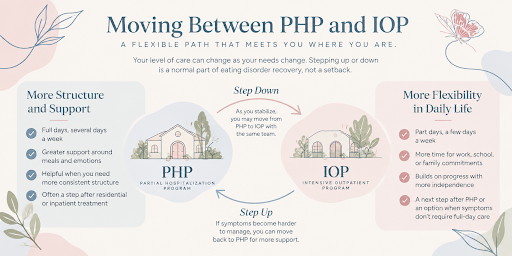
Yes. Moving between levels of care is a normal part of eating disorder recovery, not a setback.
Many women who start in PHP step down to IOP as they stabilize. Stepping down means you’re ready to practice more of recovery in daily life, with fewer hours in treatment and the same program behind you. It’s a gradual shift, not a sudden drop-off in support.
Sometimes the move goes the other way. If symptoms get harder to manage in IOP, stepping back up to PHP gives you more structure for a while. That isn’t failure. Recovery is rarely a straight line, and adjusting your care to meet where you are is exactly how treatment is supposed to work.
How Revelare’s PHP and IOP Programs Work Together
At Revelare, PHP and IOP are one program with two levels of care. That continuity is the point. You don’t have to start over with a new team or a new approach when your schedule changes.
Across both levels, women work with a primary therapist, group therapists, and a registered dietitian who specializes in eating disorders. Treatment draws on approaches like cognitive behavioral therapy (CBT), dialectical behavior therapy (DBT), acceptance and commitment therapy (ACT), eye movement desensitization and reprocessing (EMDR), and somatic therapy, matched to your history rather than a template.
Our program is women-only and trauma-informed. Many women with eating disorders also live with anxiety, depression, trauma, or substance use, and we treat those alongside the eating disorder so your care isn’t split across providers.
Find the Right Starting Point
If you’re unsure whether PHP or IOP fits, that’s exactly what a first conversation is for. Learn more about our eating disorder treatment for women in Atlanta, or reach out to our admissions team for a confidential, no-pressure call.