
What Depression Treatment Actually Looks Like
If you’re considering treatment for depression, it’s normal to wonder what you’re actually signing up for. Many women put off getting help because they picture a hospital ward, a long stay away from home, or a provider who hands over a prescription and little else. Structured outpatient care usually looks very different from that.
At Revelare Recovery, women receive depression treatment through two outpatient levels of care: a partial hospitalization program (PHP) and an intensive outpatient program (IOP). You go home each evening, and your care is built around what you’re actually living with, including any anxiety, trauma, eating concerns, or substance use that shows up alongside depression.
This page is for general education and isn’t a diagnosis or a substitute for care from a licensed provider. If you’re thinking about suicide or are in crisis, call or text 988 to reach the 988 Suicide & Crisis Lifeline, or call 911 in an emergency.
Assessment and Intake: Where Treatment Begins
Treatment starts with a conversation, not a commitment. When you first reach out, our admissions team listens to what’s been happening, answers your questions, and helps you check your insurance benefits. You don’t need to have everything figured out before you call.
If a program looks like a good fit, the next step is a clinical assessment. A clinician will ask about your mood, sleep, appetite, energy, and how depression is affecting your work, relationships, and daily routines. They’ll also ask about your history, including past treatment, trauma, physical health, eating patterns, and any alcohol or drug use, because these often affect how depression shows up and how it heals.
The assessment helps your team recommend a level of care and build a treatment plan around your goals. It’s also a chance for you to ask what a typical day looks like, who will be on your care team, and how progress is measured.
Find out if your insurance will cover the cost of treatment.
"*" indicates required fields
What a Partial Hospitalization Program Looks Like
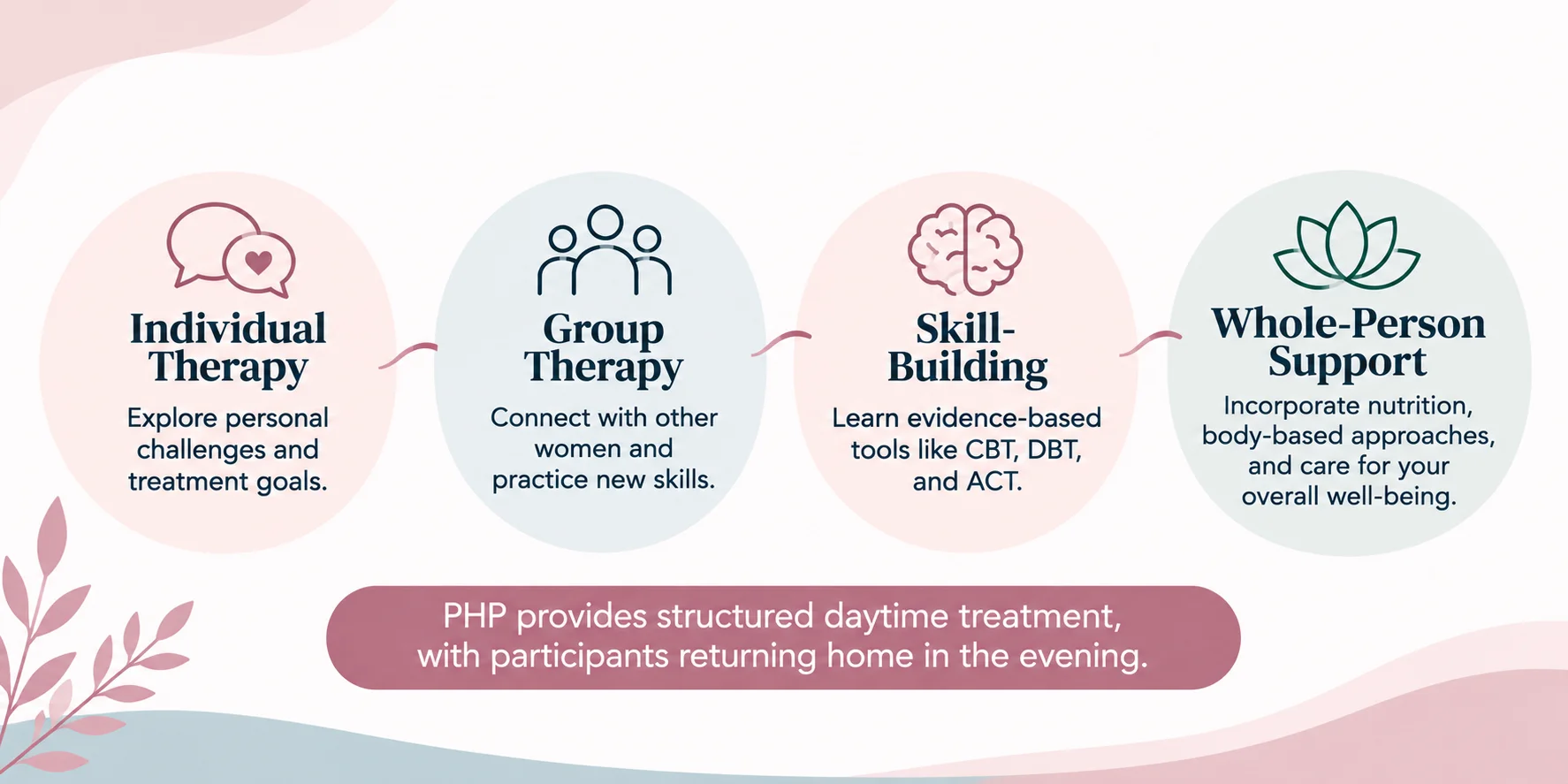
A partial hospitalization program is the most structured level of care we offer. It’s designed for women whose depression is making it hard to get through the day, but who don’t need an overnight hospital stay. You attend programming for most of the day, several days a week, and return home in the evening.
A typical PHP day combines several kinds of support:
- Individual therapy: one-on-one time with your primary therapist to work through what’s driving your depression and track your goals
- Group therapy: small, women-only groups where you practice skills and hear from others who understand what you’re facing
- Skill-building: practical tools from approaches like cognitive behavioral therapy (CBT), dialectical behavior therapy (DBT), and acceptance and commitment therapy (ACT) for managing difficult thoughts and emotions
- Whole-person care: support such as nutrition counseling and somatic, body-based work that helps calm the nervous system
PHP gives you consistent daily contact with your care team, which can matter most when depression feels heavy and motivation is low. As you stabilize, many women step down to IOP rather than leaving structured care all at once.
What an Intensive Outpatient Program Looks Like
An intensive outpatient program offers fewer hours each week than PHP. It gives you room to return to work, school, or family responsibilities while you keep getting regular therapeutic support. Revelare also offers an evening IOP option, which can make it easier to keep a daytime work schedule.
IOP uses many of the same elements as PHP, including group therapy, individual sessions, and skill-building, spread across fewer days or shorter sessions. The focus often shifts toward using your new skills in daily life: handling stress at work, setting boundaries in relationships, and noticing early signs that your mood is slipping.
IOP can be a step down from PHP, or it can be where you start if your symptoms are serious enough to need more than weekly therapy but you’re still able to manage most of your daily life.
What Depression Treatment Addresses
Good depression treatment looks beyond the symptoms on the surface. Low mood, exhaustion, and losing interest in things you used to love are real and painful, but they’re often connected to something deeper.
For many women, depression is tangled up with other experiences: unresolved trauma, chronic stress, grief, burnout from caring for everyone else, or long-standing patterns around food, body image, or substances. Treatment at Revelare is trauma-informed, which means your team pays attention to how past experiences may be shaping your mood today, and works at a pace that feels safe.
Depending on your needs, treatment may help you:
- Understand what tends to trigger or deepen your depression
- Learn skills for handling painful emotions without shutting down
- Challenge harsh, self-critical thinking
- Rebuild daily routines around sleep, meals, and movement
- Strengthen relationships and ask for support
- Address co-occurring anxiety, trauma, eating concerns, or substance use in the same plan
Timelines and What to Expect
There’s no set timeline for depression treatment. How long you stay in each level of care depends on your symptoms, your progress, and what your care team recommends. Your plan is reviewed as you go, and your team will talk with you before any change in your level of care.
Progress usually isn’t a straight line. Some women notice small changes first, like sleeping a little better or having more energy for daily tasks, before their mood starts to lift. Hard days during treatment are common and don’t mean it isn’t working. If your plan includes medication from a prescriber, keep in mind that antidepressants often take several weeks to reach their full effect, and changes should always be made with your prescriber.
Treatment is also about preparing for life after the program. Before you finish, your team will help you plan for ongoing support, such as outpatient therapy, so you can keep building on the progress you’ve made.
Related Reading
- Take the depression self-test to reflect on what you’ve been experiencing
- Learn more about our partial hospitalization program (PHP)
- Learn more about our intensive outpatient program (IOP)
Take the First Step Toward Feeling Like Yourself Again
Depression can make reaching out feel like one more thing you don’t have the energy for. A first call is simply a private conversation: we’ll listen, answer your questions, and help you understand which level of care may fit.
Call Revelare Recovery at (404) 620-5169, or verify your insurance coverage online to see what your plan may cover. You can also read more about how we approach depression treatment for women in Atlanta.