
What to Expect in Eating Disorder Treatment at Revelare
If you’re thinking about getting help for an eating disorder, the unknowns can feel as heavy as the eating disorder itself. What happens on the first day? Will you have to eat in front of people? How much of your life will treatment take up?
This page walks through what to expect in eating disorder treatment at Revelare Recovery, our women-only center in Atlanta. You’ll see how the process starts, what a day looks like in each level of care, who you’ll work with, and how treatment changes as you get stronger. You don’t need to have everything figured out before you reach out. You just need to know what you’re walking into.
It Starts With One Confidential Call
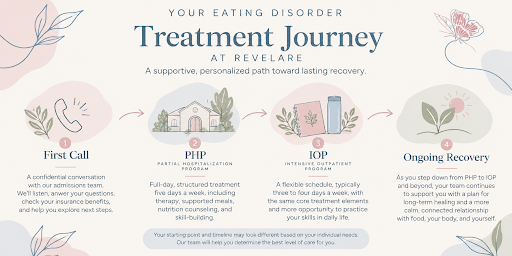
The eating disorder treatment process begins with a conversation, not a commitment. When you call (404) 620-5169, someone from our admissions team will listen to what’s been going on and ask a few questions about your eating, your health, and your daily life. You can share as much or as little as you’re ready to.
The call is confidential and there’s no obligation to start treatment. From there, our team will:
- Talk through your concerns and help you understand which level of care may fit what you’re experiencing
- Check your insurance benefits so you know what coverage may look like before you decide anything
- Plan next steps with our team if you’d like to move forward
Our clinicians will then get a fuller picture of your physical and emotional health. That’s how we decide together whether you’d start in our partial hospitalization program (PHP) or our intensive outpatient program (IOP), and it shapes the treatment plan built around you.
If a parent, partner, or friend is making the first call for you, that’s welcome too.
Find out if your insurance will cover the cost of treatment.
"*" indicates required fields
What a Day in PHP Looks Like at Revelare
Partial hospitalization is our most structured level of care. You attend full days of treatment, five days a week, then go home in the evening or stay in our supportive housing near the center. It’s designed for women who need consistent, daily support but don’t need to stay overnight in a hospital.
No two days are identical, but a typical day in eating disorder treatment at our Atlanta center includes:
- Group therapy using approaches like cognitive behavioral therapy (CBT), dialectical behavior therapy (DBT), and acceptance and commitment therapy (ACT) to work with the thoughts, emotions, and urges that drive eating disorder behaviors
- Supported meals and snacks eaten with staff and peers, so practicing new patterns with food happens in real life and not only in a therapy room
- Individual therapy with your primary therapist, where you explore what sits underneath the eating disorder, including trauma, anxiety, or perfectionism, using approaches like eye movement desensitization and reprocessing (EMDR) when trauma is part of your story
- Nutrition counseling with our registered dietitian, who helps you build a meal plan and a calmer relationship with food
- Skill-building and experiential work such as somatic therapy, mindfulness, and expressive activities that help you reconnect with your body
Meal support is often the part women worry about most. You won’t be left alone with it. Staff sit with you, help you through the hard moments, and process what came up afterward.
What a Day in IOP Looks Like
Our intensive outpatient program meets three to four days a week, with fewer hours per day than PHP. That leaves room for work, school, or caring for your family while you stay in regular treatment.
IOP keeps the same core pieces as PHP, in a lighter dose:
- Group therapy focused on skills you can use between sessions, especially around meals, body image, and difficult emotions
- Individual therapy to keep working on the patterns and history behind the eating disorder
- Ongoing nutrition support with the dietitian as you take on more meals and snacks on your own
- Supported meal practice on program days
The biggest difference is how much of recovery happens outside our walls. In IOP, you’re testing your skills at home, at work, and at restaurants, then bringing what went well and what felt hard back to your team. Some women step down into IOP after PHP. Others start here when their symptoms don’t call for full-day care. If you’re not sure which fits, our admissions team can walk you through the difference.
How Treatment Progresses: Stepping Down From PHP to IOP
At Revelare, PHP and IOP work as one program with two levels of care. That means you don’t go from full-day treatment straight back to life on your own. You step down gradually, with the same team, as you stabilize.
There’s no fixed timeline. Your team looks at how you’re doing with meals, how you’re managing urges and emotions, your physical health, and how ready you feel. When the time is right, you’ll talk about moving from PHP to IOP together, and your schedule shifts to fewer days while your care team continues to support you.
Stepping down isn’t the end of support. It’s a sign you’re ready to practice more of recovery in your own life, with your team still close by. As you near the end of IOP, your team will help you plan for ongoing support after you finish.
Who You’ll Work With
Eating disorders affect the mind and the body, so your care comes from a team rather than one person. At Revelare, that team includes:
- A primary therapist who leads your individual sessions and coordinates your treatment plan
- A registered dietitian who specializes in eating disorders and works with every client directly, because nutrition counseling is a core part of care here, not an add-on
- Group therapists and program staff who run groups and provide meal support throughout the day
- Clinical leadership, including our clinical director, who oversees treatment planning and keeps your care consistent across levels
Because many women with eating disorders also live with anxiety, depression, trauma, or substance use, the same team can address those conditions alongside the eating disorder. You won’t have to split your care across different providers to be seen as a whole person.
What the First Week Feels Like
Most women feel nervous walking in on the first day. Some feel relieved. Many feel both. All of that is normal.
The first week is mostly about getting your footing. You’ll meet your therapist and dietitian, learn the rhythm of the day, and start to get to know the other women in the group. Meals may feel hard at first, and the eating disorder may get louder when you start to challenge it. That isn’t a sign you’re failing. It’s often a sign the work has started.
You won’t be expected to have the right words or to change everything at once. Your team will meet you where you are. For many women, the hardest part is making the call. Being surrounded by other women who understand can make the first days easier than expected.
Take the Next Step
Now that you know what to expect, the next step is finding out whether our program is the right fit. Learn more about our eating disorder treatment for women in Atlanta, or reach out to our admissions team for a confidential conversation.
Stories of Healing and Support
Reflections shared about Revelare Recovery


Reveal Your AUTHENTIC SELF at Revelare
To start caring for and supporting who you genuinely are, contact the team at Revelare Recovery in Atlanta. Our experienced counselors, therapists, and other professionals specialize in helping you uncover the root causes of your struggles with food and body image so that you can reclaim your health and well-being. Speak with someone from our experienced and compassionate team today.
A private, judgment-free conversation
We start by listening and helping you understand what kind of support may be the best fit for you.
Clear guidance around insurance and costs
We walk you through coverage and financial options so there are no surprises.
Confidential support, when you’re ready
Areas We Serve in the Atlanta Metro Area
- Atlanta
- Buckhead
- Kirkwood
- Candler Park
- Lake Claire
- Decatur
- Midtown
- Grant Park
- Druid Hills
- Fayetteville
- Eastlake
- Brookhaven
- Sandy Springs

Revelare Recovery
Address
Phone


Website by Kee Group Marketing